
Mutually Assured Construction
We all build, or the vultures build for us.

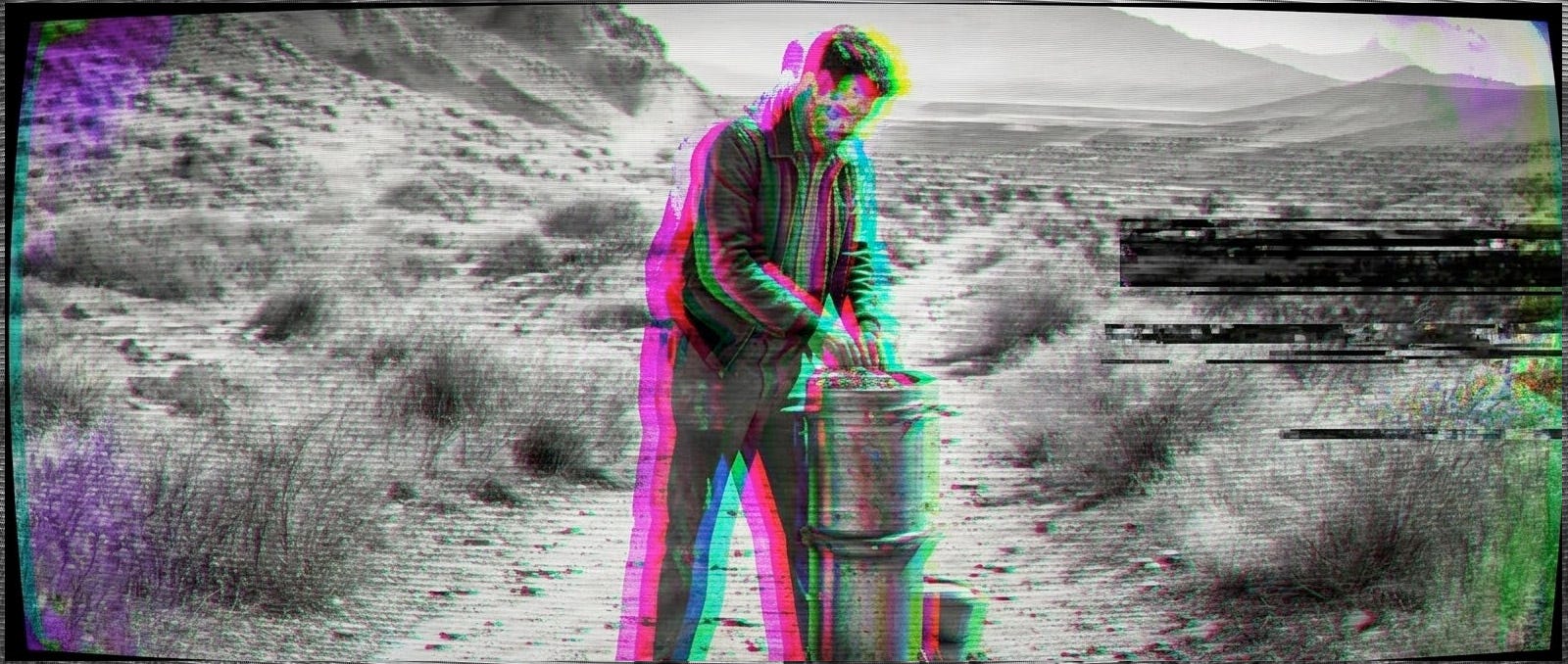
In 1942, a man named Jack Parsons stood in an arroyo in Pasadena, California, packing a steel chamber with a mixture that every legitimate chemist in America said would kill him.
He was not a credentialed scientist. He was a self-taught chemist from a wealthy family who read too much science fiction and developed an unshakable conviction that solid-fuel rocketry was a solvable problem. Caltech let him use their facilities, but they kept him at arm’s length, the way institutions always keep anyone whose ambition outpaces their pedigree. His colleagues were a handful of grad students and misfits that the faculty called the Suicide Squad (and they meant it as a warning, not a compliment).
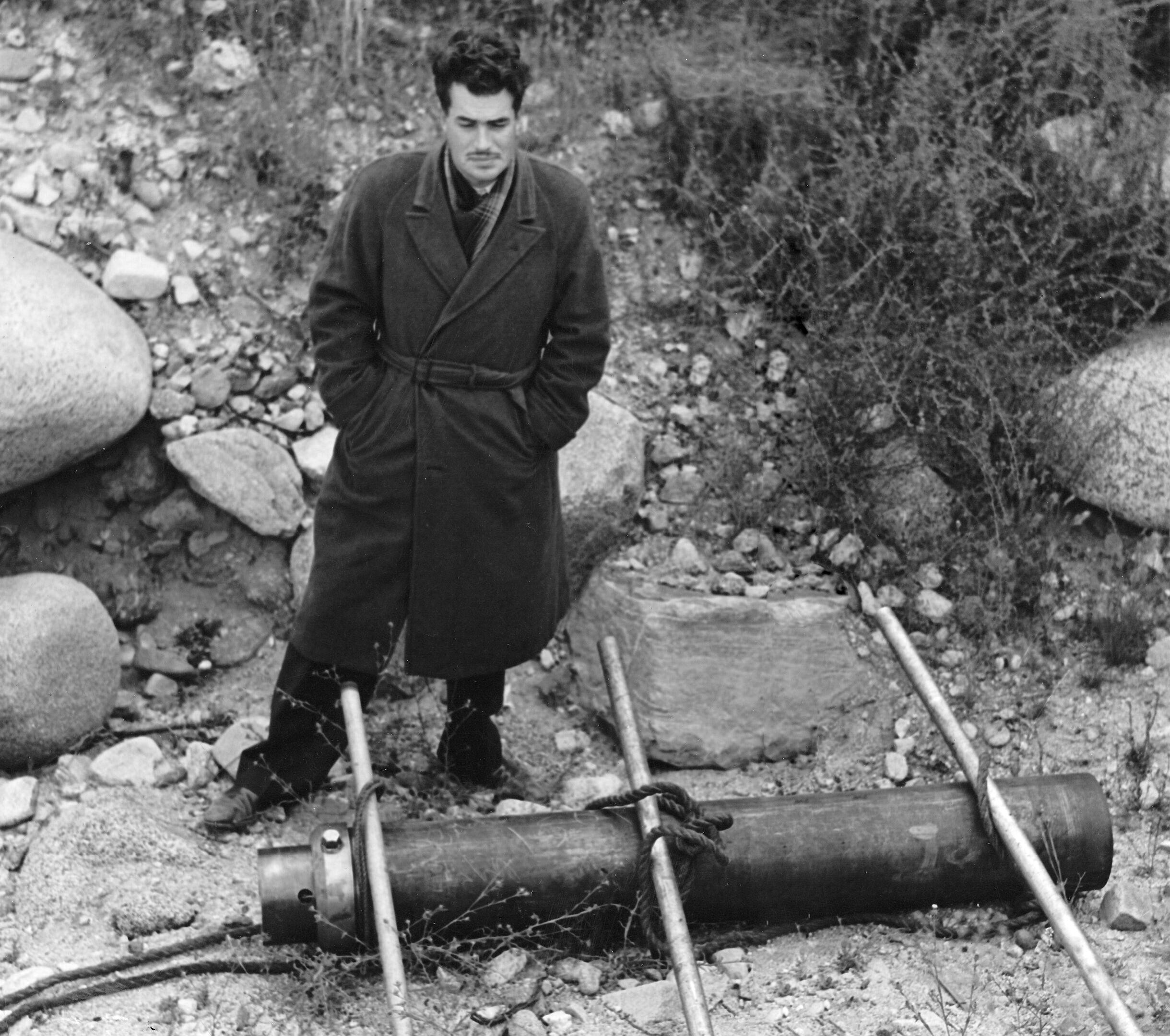
The Southern California heat pressed into the arroyo like a weight. Dust and scrub brush. The kind of place you go when the laboratories will not have you. Parsons packed the chamber anyway. He had the certainty of a man who sees a solution nobody else can see, and that certainty made him luminous and dangerous in equal measure. He named his operation the Jet Propulsion Laboratory because “rocket” sounded too much like Buck Rogers. The word itself was embarrassing. Serious scientists did not say “rocket.” So he found a word the establishment could tolerate, packed his steel chamber, and lit the fuse.
They were not wrong about the mixture. They were wrong about the timeline. And, Parsons did die in an explosion in his home laboratory in 1952. He was 37, and without him, the course of human spaceflight might have been much different. But before we get to that, we need to talk about what he built first.
A Fuse Has Been Lit
We are in a Parsons moment. Right now. In this industry.
There are people building things the establishment says cannot work, should not be attempted, and will embarrass anyone associated with them. The tools are unstable. The methods are unproven. The credentials of the people doing the work are, in many cases, the wrong credentials. Designers who code. Researchers who ship. Writers who architect systems. People whose job titles do not exist yet but who are producing things that the correctly-credentialed cannot.
You can feel it if you are paying attention. The energy right now is half exhilaration, half terror. People are shipping things in weeks that used to take quarters. They are combining disciplines that the organizational chart says should never touch. And the establishment response is predictable: slow down, be careful, you do not have the credentials, this will end badly. You’ll blow yourself up.

The establishment is not wrong to be cautious. Parsons did blow himself up. But the establishment was wrong about the science. The arroyo in Pasadena became the Jet Propulsion Laboratory. The crank’s work became the foundation of American rocketry.
And right now, across this industry, there are people standing in their own arroyos, packing their own chambers, being told by reasonable people that the mixture is too volatile. They are right about the volatility. They are wrong about the science.
Whether these tools work is no longer the debate. Who gets to shape what they become is. It was a rocket that took us to the moon, that put satellites into orbit, that took the Curiosity Rover to Mars. The Saturn V took Apollo 11 to the moon. But, if you put an explosive on the top of a rocket, you get the Saturn V’s ancestor, the V-2. One you can aim toward the stars, and one you can aim toward… well…
The V-2 Was Built by Slaves
If you grew up in mid-century America, you knew Wernher von Braun’s face. He was on the cover of Time magazine. He appeared on Walt Disney’s television program in the 1950s, standing in front of beautiful painted illustrations of space stations and lunar landers, explaining to American families how we would reach the moon. He was handsome, articulate, and radiantly confident. Disney called the series “Man in Space” and von Braun was the star.
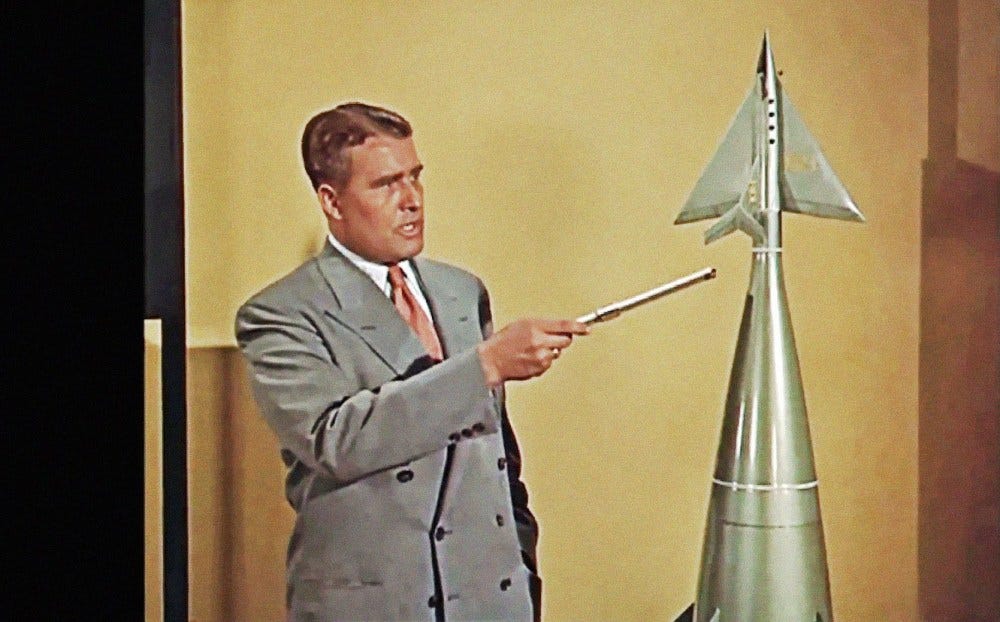
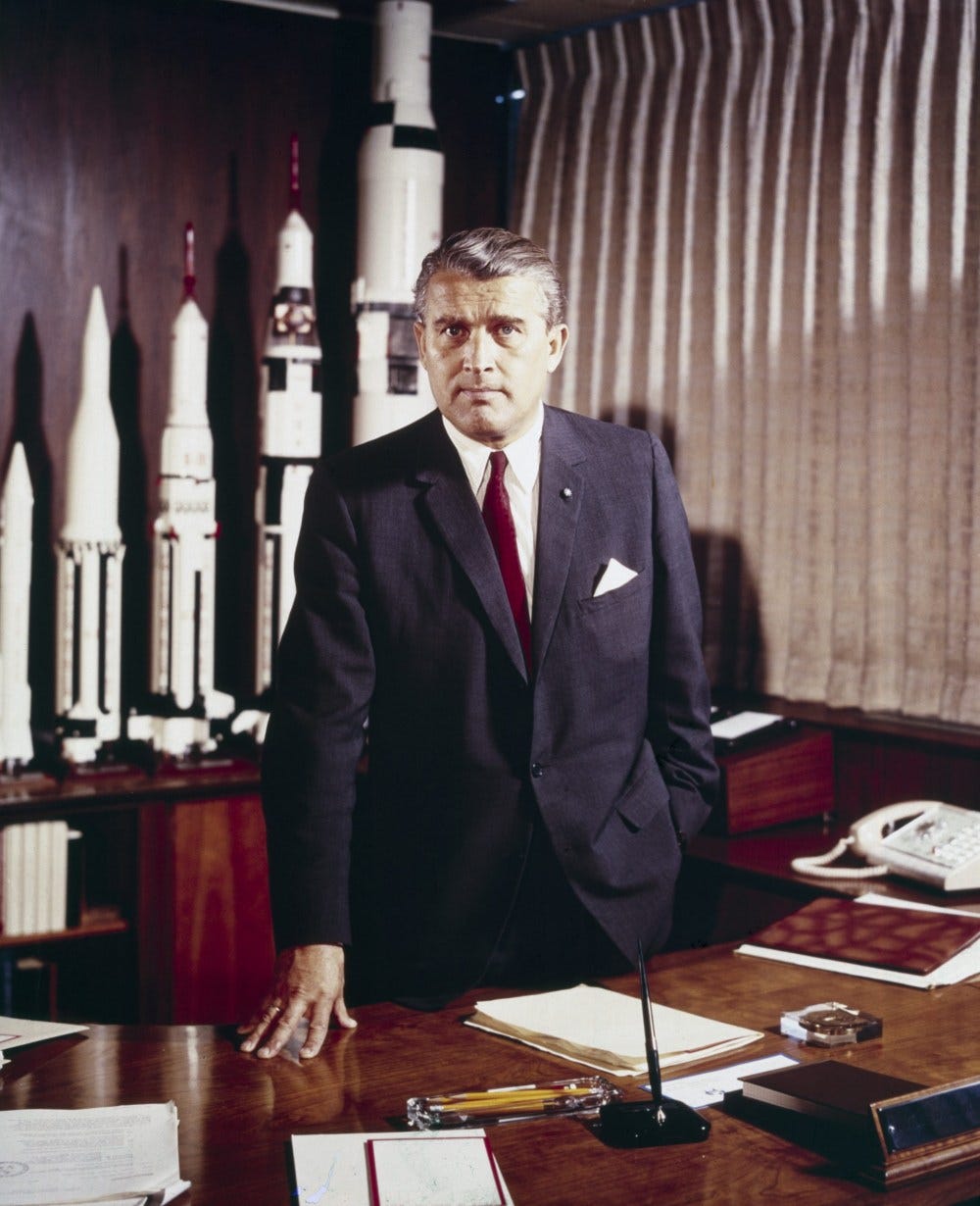
In 1960, his rocket development operation was transferred to the newly created NASA, where he became the first director of the Marshall Space Flight Center in Huntsville, Alabama. He was not a contractor or a consultant. He was the agency’s chief architect of human spaceflight. NASA’s moonshot was, in the most literal sense, his program.
He delivered. He designed the Saturn V, the most powerful rocket ever built, the vehicle that carried Apollo 11 to the moon in 1969. He was the father of American spaceflight, the man who turned science fiction into a national achievement broadcast on live television to 600 million people. Schools were named after him. He received the National Medal of Science. He was, by every measure the American public had available, a hero.
This is where the story gets uncomfortable, but the dark history of rocketry should not be avoided. And, if you’re skeptical about AI, I am certain you will appreciate an unflinching acknowledgement of this parallel.
Wernher von Braun was an SS officer. The V-2 was the world’s first long-range guided ballistic missile, built to rain explosives on London from mainland Europe. It was also the first human-made object to reach space. Mittelwerk, the factory where the V-2 was assembled, used forced labor from the Mittelbau-Dora concentration camp. More people died building the V-2 than were killed by it. Von Braun knew. There is no historical ambiguity here.
He worked for Hitler.
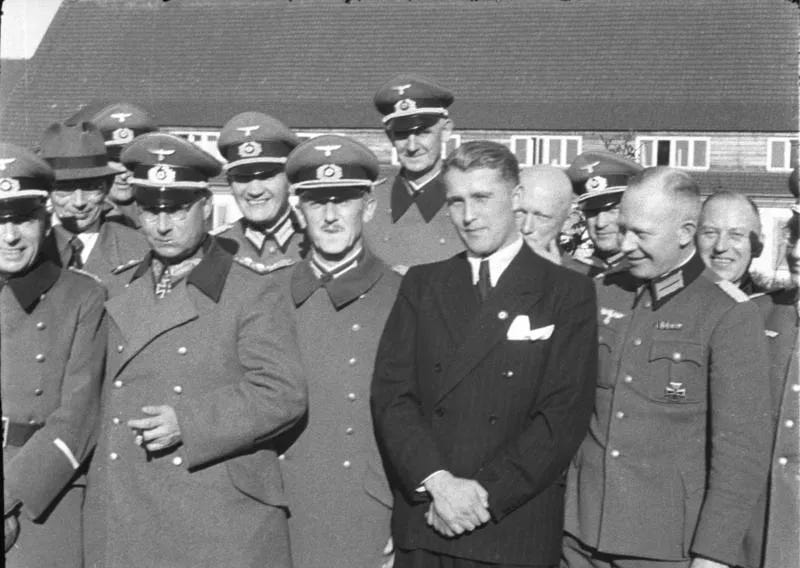
And then Operation Paperclip brought him to America, scrubbed his record, and gave him the Saturn V. The rocket that put humans on the moon was designed by a man who had been, by any reasonable definition, a war criminal.
I point this out not to sensationalize or distract from the point: this is the point.
Every powerful technology carries the fingerprints of the context that created it. Design thinking was born in corporate consulting and refined in Silicon Valley, where it was used to optimize engagement metrics that harmed people. The same AI that fuels our creativity right now is also, at this very moment, operating autonomous lethal military systems. The origins are never clean. They were not clean for rocketry. They are not clean for us.
Tom Lehrer said it best, as he usually did: “Once the rockets are up, who cares where they come down? That’s not my department, says Wernher von Braun.” The joke is devastating because it is not actually a joke. It is the exact posture we cannot afford to take.
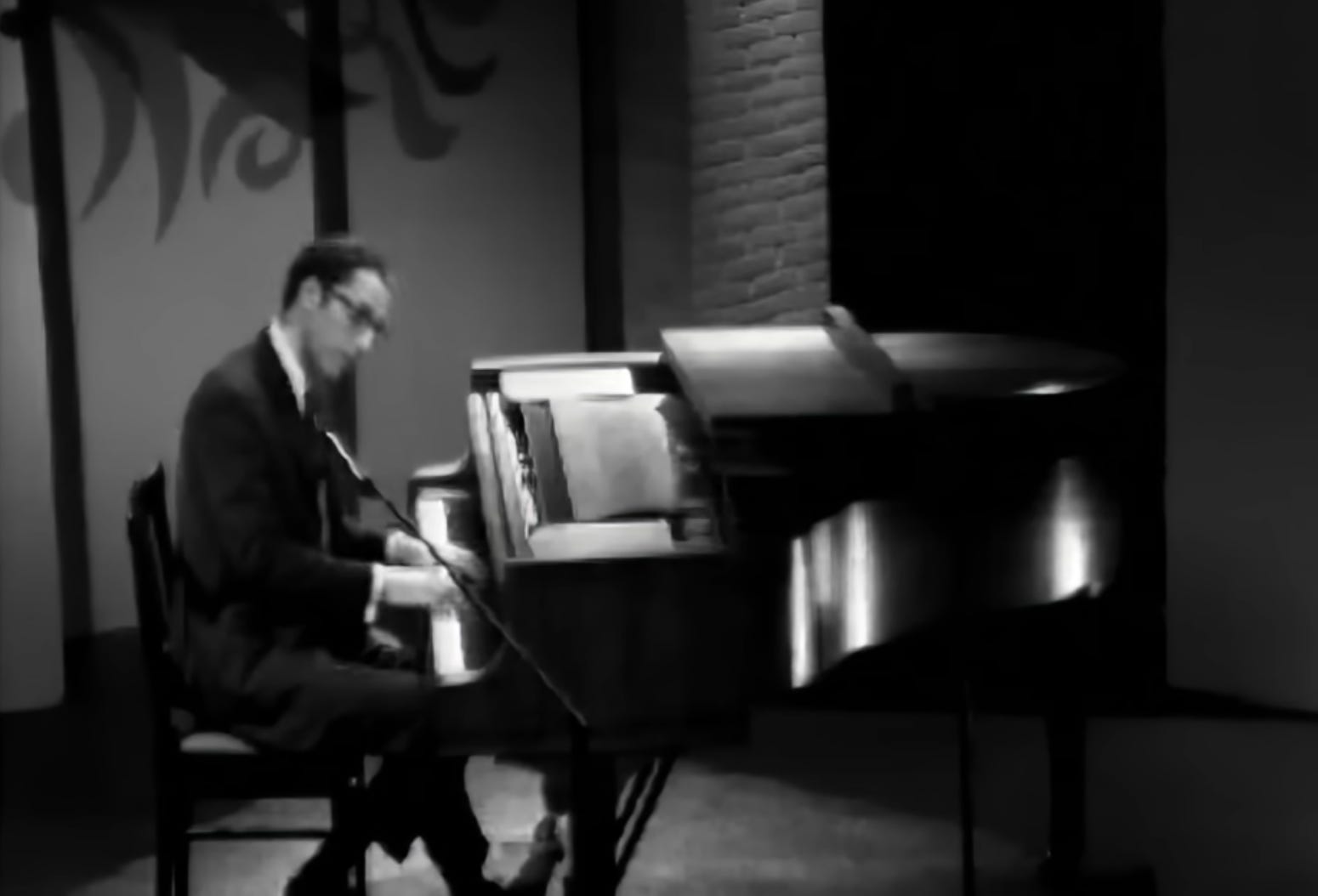
The question is not “are the origins clean?” They never are. We do not get to choose the inheritance. We only get to choose what we build on top of it. Armstrong’s first step on the moon was made possible by the Saturn V, and now some 70 years later, everyone knows about “one small step for a man” and you would be hard-pressed to find anyone who even knows what the V-2 was.
The rocket that took us to the moon was born from the machines of terror and death, but history records the hope and exploration that overshadowed the darkness.
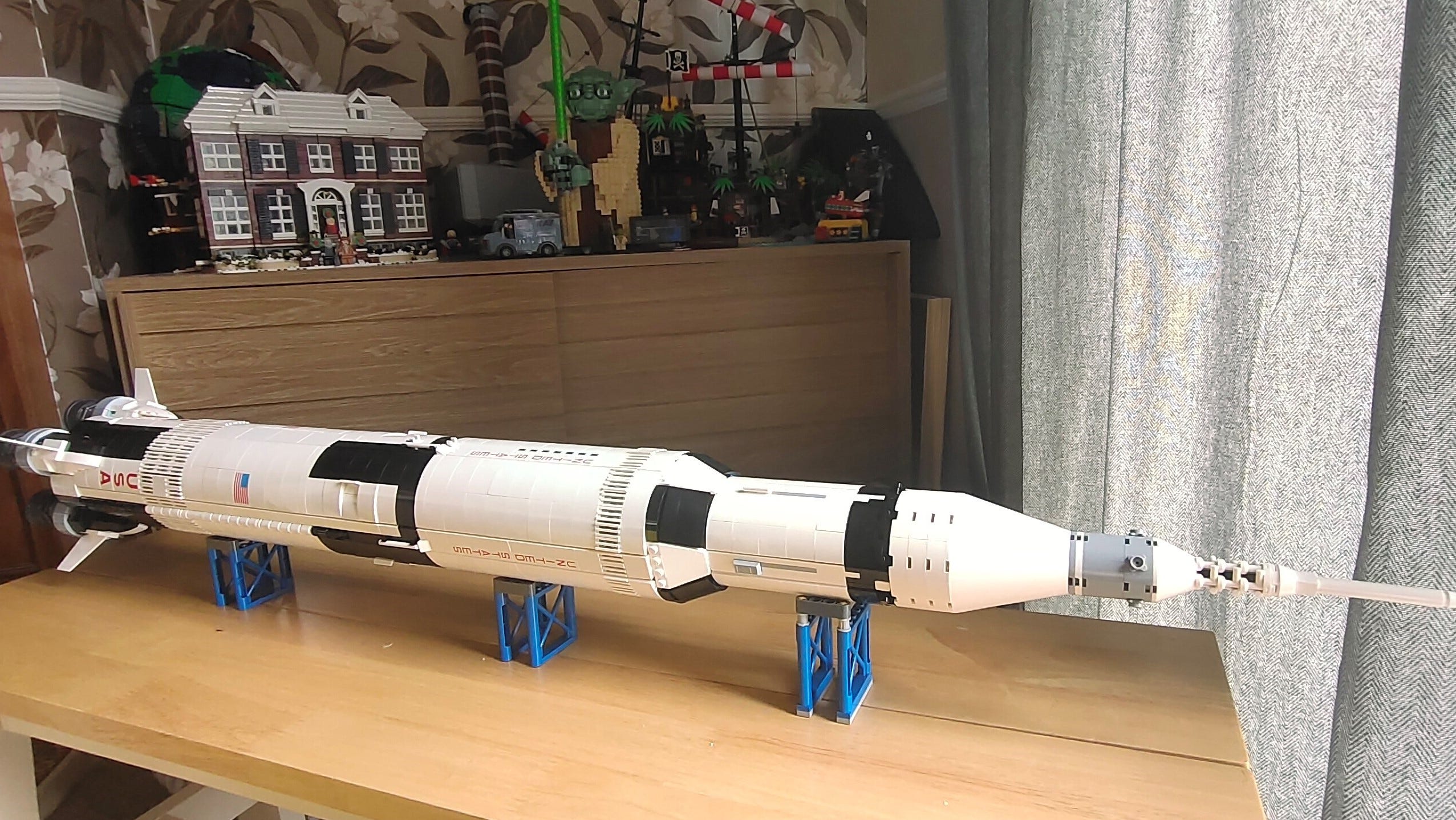
There is a Saturn V LEGO set. There is not one of the V-2.
Parsons, Hubbard, and the Moonchild
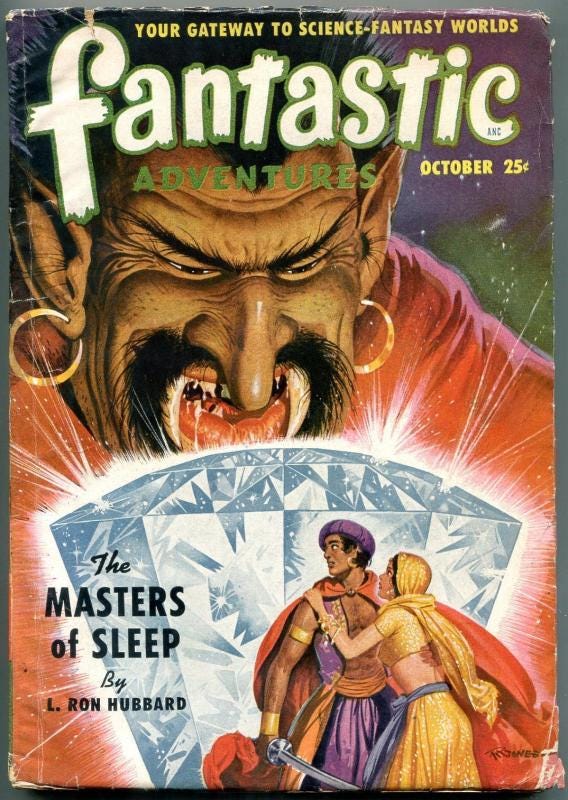
Now, back to Parsons. Before he died, Parsons was deep into Aleister Crowley’s Thelema. He performed occult rituals in his Pasadena mansion. L. Ron Hubbard (yes, that L. Ron Hubbard) moved in, ran a con on Parsons, stole his money and his girlfriend, and went on to found Scientology.
So what did Parsons do? He responded by trying to summon a demon to get revenge. I mean… I get it.
This is not a footnote. This is the man who invented solid rocket fuel. And, on June 17, 1952, Parsons dropped a container of fulminate of mercury in his home lab in Pasadena. The explosion tore off his right forearm and shattered the right side of his face. He was conscious when they found him. He died at the hospital thirty-seven minutes later. He had been preparing for a trip to Mexico to do explosives work. He was still packing chambers, while surrounded by conspiracy about espionage, magic, and the occult.

But that is how it is sometimes. Genius and obsession are neighbors. The same single-minded intensity that let Parsons solve a problem every chemist said was unsolvable also made him vulnerable to grifters, cults, and self-destruction. That pattern repeats. The people pushing the boundaries of any field are, almost by definition, a little unhinged. The intensity that cracks the impossible problem is the same intensity that opens the door to charlatans who speak your language and mirror your conviction.
The deeper I get into agentic workflows, giving my agents personalities, vocal tics, and dialogue, treating them like living, thinking beings that just happen to be trapped in the computer, I recognize my own version of this. That is my Aleister Crowley, my L. Ron Hubbard, my blending of the occult and the scientific and the fictional. I am fully aware of how it sounds.
And honestly, I think the awareness is the only thing keeping me on the right side of the line. Constraining yourself to the established norms and boundaries will do exactly that: constrain you. Arthur C. Clarke said “the only way of discovering the limits of the possible is to venture a little way past them into the impossible.” We don’t know what is on the other side of the sky, and we can’t find out unless we try.
Can you be Parsons in the arroyo without being Parsons in the mansion? Can you channel the obsession without the self-destruction? Can you pack the chamber and light the fuse without blowing up your life?
I do not know. But I know the alternative is not packing the chamber at all. And that is worse. Because if we don’t, those of lesser morals will.
We Retired the Space Shuttle
Parsons blew himself up in 1952. By 1969, we were on the moon. By 1981, we had the Space Shuttle. By 2011, we retired it. By 2025, private companies are launching rockets on a schedule that would have been unthinkable to NASA in the 1990s. Parsons was a wealthy person who was laughed at for pursuing rockets. Today? It’s the wealthy’s number one vanity pursuit.
The arc from “impossible” to “routine” took 70 years for rocketry.

The arc for agentic design is going to be faster. Not because we are smarter. Because the infrastructure already exists. We are not inventing the fuel. We are inventing the guidance system.
Consider the shuttle for a moment. Ninety-five percent overhead. 4.5 million pounds of fuel to lift 220,000 pounds of orbiter to low earth orbit. We ran that math for 30 years. Thirty years of staging, separation, heat tiles, foam insulation debates, and two catastrophic failures. And then we retired it. Because the question changed.
It stopped being “can we get to orbit” and started being “how cheaply and frequently can we get to orbit.” That is a completely different engineering problem. And it required a completely different architecture.
That is where we are right now. The question is no longer “can AI do design work.” The question is “how do we make it reliable, repeatable, and safe.” That is a guidance system problem. That is Zero Vector.
And just as the shuttle’s retirement was not a failure but a recognition that the architecture had reached its limits, the disruption of traditional design workflows is not a loss. It is a signal that the question has matured. The space shuttle system is the perfect example for the old way of doing things, and most people don’t even realize we retired it 15 years ago. The space shuttle is a part of history, not the present.
The Lab in the Arroyo
Parsons named his research center “The Jet Propulsion Laboratory” because “The Rocket Laboratory” was embarrassing. The word carried too much science fiction baggage. Serious people did not say “rocket.” And today, JPL is among the most respected science institutions in all of human history. Ever.
I named my laboratory “Zero Vector” because “prompt engineering” or “vibe coding” is embarrassing. The phrase carries too much tech-bruh baggage. Serious designers do not say “prompt engineering.” And I did not want to call it “agentic design” or “agentic development” either, because frankly, I do not know what this is going to become. The name needs room to grow. It is a starting point, a zero vector of infinite potential.
The Jet Propulsion Laboratory still exists. It is one of the only organizations on Earth that has landed a fully capable, semi-autonomous robot (the adorable one) on another planet. JPL went from a handful of misfits in Arroyo to one of the most respected institutions in aerospace, a trajectory that Parsons, who died at 37, never got to see.
From summoning a demon to attack L. Ron Hubbard to putting a robot on another planet. Same lineage.
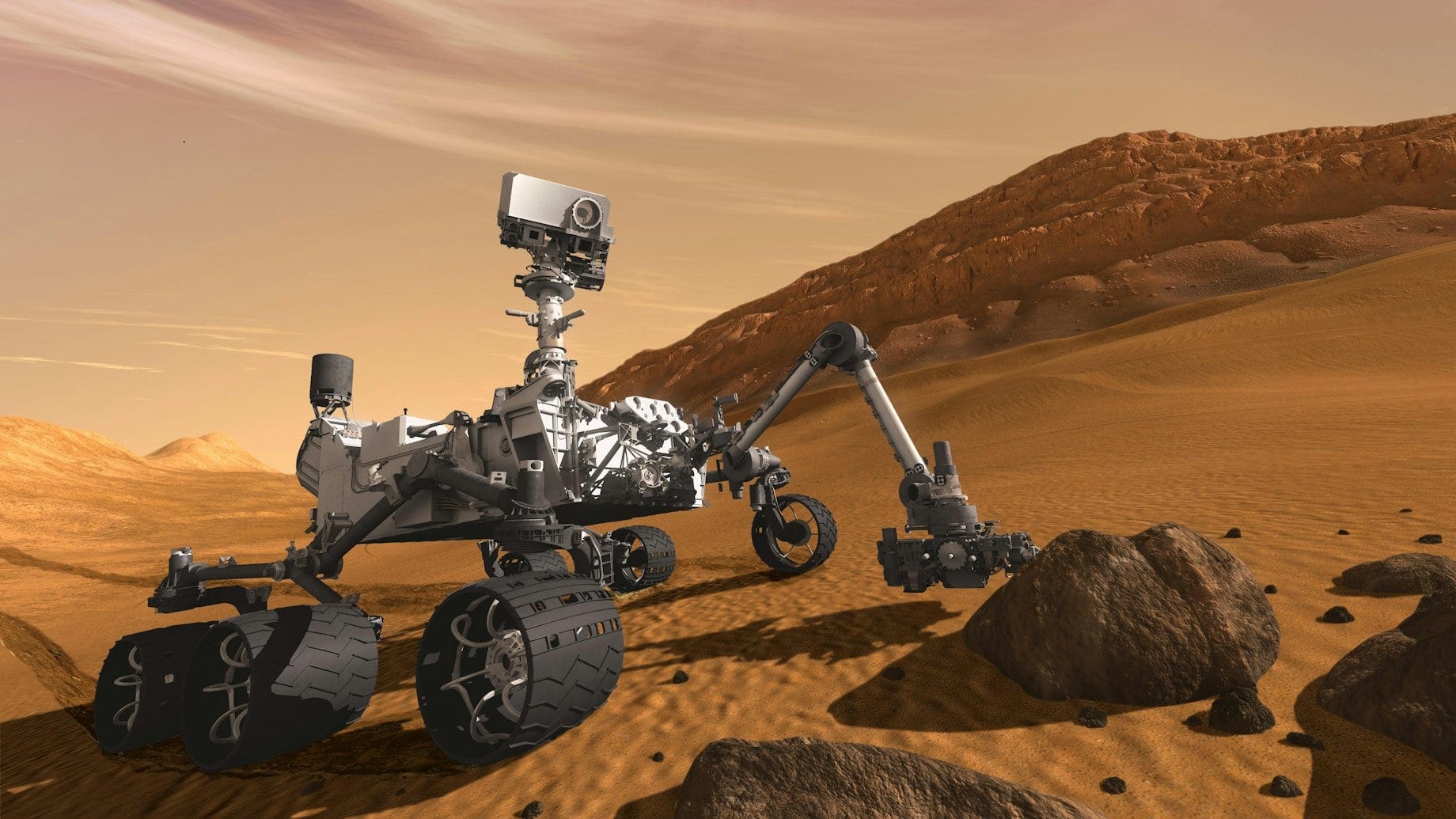
This is The Space Elevator
The equation shifts in our favor from here, and it shifts hard.
Parsons could not do it alone. Even if he had not blown himself up, he could not have built a rocket to take himself to the moon. Von Braun needed the entire United States military, which later became NASA, to launch his. Physics is an unbending, cruel mistress. They could not do this without the entire force of massive institutions backing them up.
But we can. That is the thing I think scares everybody.
This is not just about “great power and great responsibility.” It puts the onus on the individual. On the designer. On the person who now, even if they cannot completely build their rocket and get to another planet, can get most of the way there. They can, almost over a weekend, start becoming system architects. They can look into what makes technology stable, performant, safe, and humane. They can start building things, and they can finally break the cost/value/time tradeoff that traditional took teams and immense overhead to accomplish.
And this is not about vibe coding another to-do list or a chess app. This is about turning the entire system inside out, so every designer who feels like they are losing their voice, losing their identity, and most of all losing their autonomy to AI, stops looking at the rocket from beneath its burning engines and starts looking at it from the top.
Because that rocket was the first stage of what being a designer was. The advent of AI-driven design and development is the space elevator you take to orbit and then launch from there. It removes the reasons you needed redlines and specs and multi-month handoffs in the first place. Now you go from trying to create a plan and hoping it influences the people who implement it, to being able to take it all the way on your own, or with a team. Entire teams that used to be fragmented and federated like multi-stage rockets can now ride that elevator up together.
I do not post and write about this as a message of fear. I am imploring every designer to see it as a message of hope. The entire substrate of the industry we work in has changed, and we are uniquely positioned to be the ones at the top driving it.
We have always been human-centered, customer-driven, and looking out for the good of the people we serve. We can take that and do something better with it.
That is why we do not look away from Wernher von Braun. That is why we do not pretend Mittelwerk did not happen. Operation Paperclip, as repugnant as it was, brought that knowledge over whether we like it or not. So how much has been built on von Braun’s past? How many rockets brought satellites, astronauts, and scientists into space? How many advancements since his departure improved humanity, built on what we learned from his tainted science, built on what we learned from Parsons’ sacrifice?
We are the recipients of a dark past. But we are now in orbit. And we can explore the stars; not literally (yet), but in the sense that the positive, hopeful, optimistic impact people using AI and agentic development can have is yet to be explored. For the first time in decades, we truly have a new frontier. A space race the average person can actually participate in, but more than that, help define.
If we are going to be sending people out into space, I want some of us at the helm of these AI-powered spacecraft. I want some of us, the people with humanity and empathy and everything design thinking taught us, the people who look beyond the dollar and look at the impact on the person, to be up there.
Because if we do not do it, if we do not harness the power of AI-driven design and development, the vultures will. Like they do every single time. They already are, but so are we. A rocket with a bomb on top is a missile. A rocket with a capsule on top gave us “one giant leap for mankind.”
So, if you decry AI, you better decry everything that von Braun’s work led to. He built the V-2 that killed more slaves than it did targets. And yet it is on that same technology stack that Neil Armstrong uttered his famous phrase. And just like the Saturn V, AI will be responsible for hope, progress, and healing.
Like the rocket, it is a neutral technology. Rockets became missiles, which became ICBMS, which gave us MAD: Mutually Assured Destruction, the policy that if every nation has nuclear weapons, no one will be able to use them. But, I have a different notion to propose:
Mutually assured destruction? No. Mutually assured construction.
This is our moment. Take it and make something more of it. Mutually assured construction, as the way we move forward together with the same empathy we put into our work before the age of AI.
I am telling you this as a kid from a desert trailer park town in the middle of nowhere in southern Utah who actually did make it into NASA. I want you all to join me now in being the force for good in this space race.

I am betting my career on this; not “getting rich” by exploiting the AI gold-rush, but by trying to be a force, a vector, that helps guide it in a way that empowers people, that fosters empathy, and acts as a voice that counters the narrative of the destruction.
And I want to be honest: I am not writing this from the summit. I am writing this from the climb. I left a stable career path. I am building a methodology nobody asked for, a product nobody has seen yet, and a movement that might turn out to be me shouting into a canyon. I have a son who needs stability. I have financial obligations that do not care about my manifesto. Some mornings I wake up and think: what if I am not Parsons in the arroyo? What if I am Parsons in the mansion, chasing something that is not there?
But then I open the terminal. And the agents respond. And the thing I could see at 14, the thing I could not build for 31 years, starts taking shape. And I remember: the mixture works. I have seen it work. The question was never whether it works. The question is whether I can build fast enough, and find enough people willing to build alongside me, before the window closes or the money runs out.
Everyone Will Wonder How He Did It
Parsons did not live to see the moon landing. Von Braun did, but he carried the weight of Mittelwerk for the rest of his life. The shuttle program ran for 30 years and then ended. SpaceX exists because the question changed.
We are in the Arroyo. The mixture is unstable. The establishment, our peers, thinks we are cranks. But the science is real.
And unlike Parsons, we have something he never had: each other. A methodology. A way to teach others to do what we do, so it does not depend on one person standing alone in a canyon with a steel tube and a match.
In 1942, Parsons packed a steel chamber in an arroyo. In 1969, Armstrong stepped onto the moon. In 2011, we retired the shuttle. In 2026, private companies launch on a weekly schedule. Eighty-three years from a man alone in a canyon to routine commercial spaceflight.
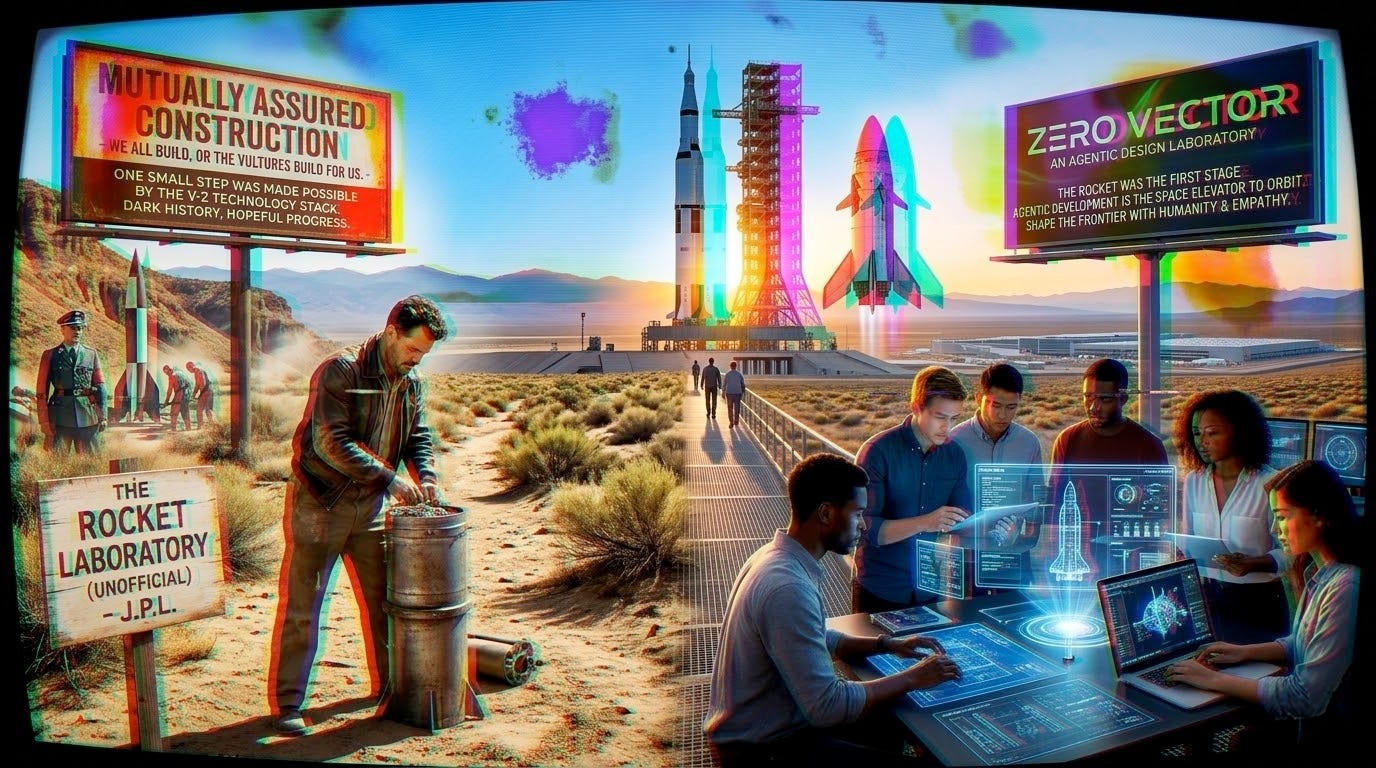
We do not have eighty-three years, but we do not need them. The infrastructure already exists. What took rocketry eight decades, agentic design will compress into less than one. The question is who is shaping it during the compression, the vultures, or the people who are too scared to be proactive.
That is what changes the calculus. Not better tools. Not smarter individuals. It will be a community of practice where the knowledge survives the person who discovered it.
That is the difference between a pioneer and a movement. Parsons was a pioneer. He lit the fuse alone. We are building a launch program.
He was not wrong about the mixture. He was wrong about doing it alone.
This article is a continuation of Zero Stage to Orbit

Love your writing. It's so informative, engaging, and deeply inspiring! And now I'm back to the Zero Vector training materials so that I can understand and contribute to what you envision.